
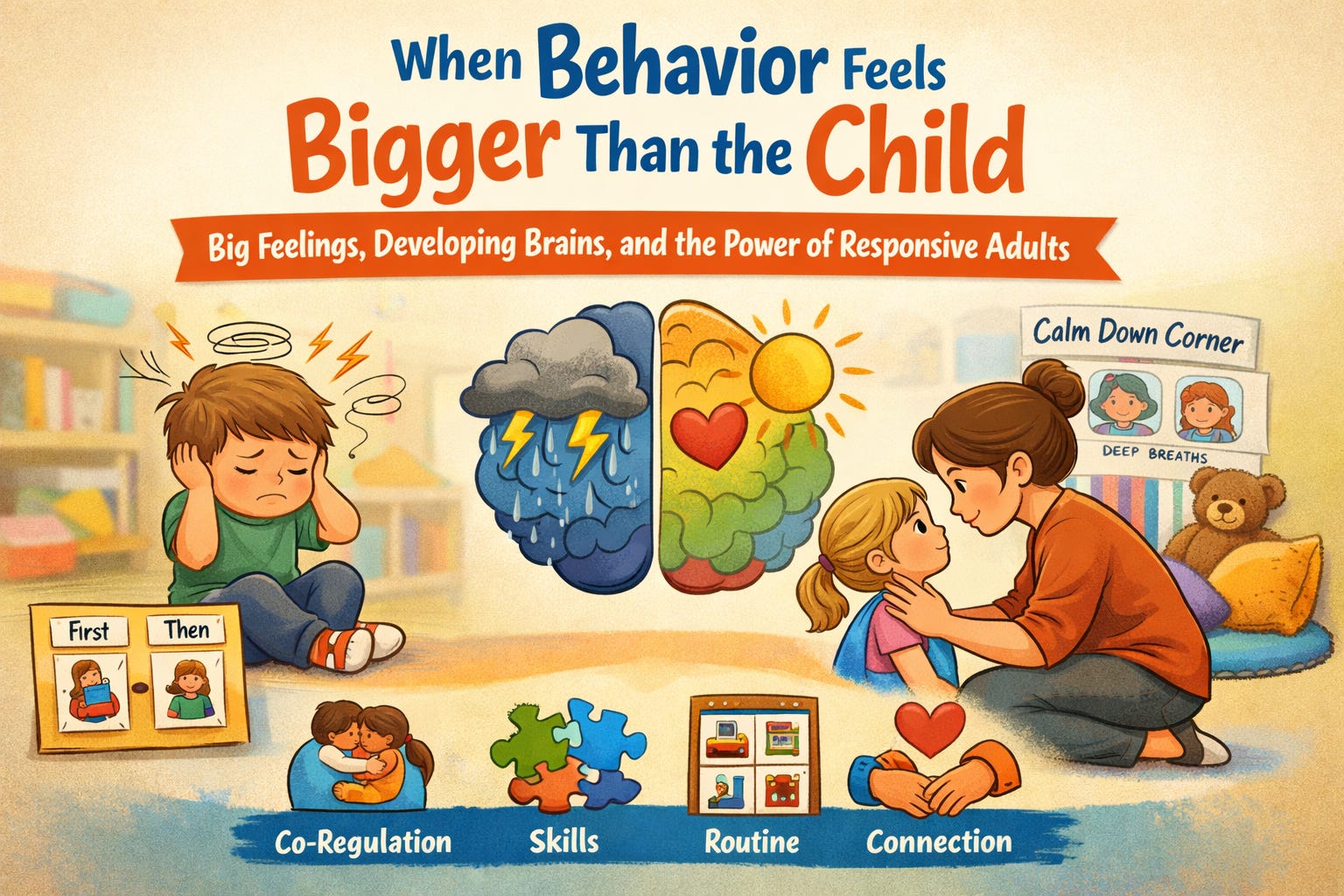
When Behavior Feels Bigger Than the Child Understanding Behavior Concerns in Young Learners
Big Feelings, Developing Brains, and the Power of Responsive Adults

If you work with young children, especially in Early Intervention, you’ve heard it:
“He’s being defiant.”
“She just won’t listen.”
“He’s doing it on purpose.”
“Her behaviors are out of control.”
But here’s the truth: we don’t say enough.
Young children are not giving us a hard time. They are having a hard time.
Behavior concerns in young learners are not character flaws. They are communicating.
And when we shift our lens from control to understanding, everything changes.
Behavior Is Communication
In early childhood, language, self-regulation, and social skills are still developing. When a child:
Hits
Screams
Refuses
Runs away
Throws materials
…it is often because they do not yet have the skills to express what they need.
Common underlying reasons include:
Limited expressive language
Sensory overwhelm
Difficulty with transitions
Anxiety in new environments
Fatigue or hunger
Skill deficits in emotional regulation
Unclear expectations
In EI settings, we must always ask the following:
Is this willful defiance, or is this a lagging skill?
Most of the time, it’s a lagging skill.
The Developmental Lens Matters
In Early Intervention and preschool settings, behavior must always be viewed through developmentally appropriate expectations.
A three-year-old:
Cannot regulate like a seven-year-old.
Cannot problem-solve like an adult.
Cannot “just calm down” on demand.
Their brains are still building the neural pathways for:
Emotional control
Impulse inhibition
Flexible thinking
Frustration tolerance
When we expect maturity before the brain is ready, we create frustration for the child and for the adults.
Red Flags vs. Developmental Norms
Not all challenging behavior signals a concern. Some behaviors are typical for young learners.
Developmentally Typical:
Occasional tantrums
Difficulty sharing
Testing boundaries
Short attention span
Big emotions
Potential Concerns When You See:
Persistent aggression beyond peers
Self-injury
Extreme withdrawal
Inability to recover from minor frustration
Behavior that significantly interferes with learning
The keyword is persistent.
We look for patterns, not isolated incidents.
What Young Children Need Instead of Punishment
When behavior escalates, our instinct may be to:
Remove privileges
Raise our voice
Send them out
Demand compliance
But young children need:
1. Co-Regulation
They borrow our calm before they can build their own.
2. Predictable Routines
Structure reduces anxiety.
3. Visual Supports
Schedules, first/then boards, and picture cues reduce confusion.
4. Explicit Teaching of Skills
We must teach:
How to ask for help
How to wait
How to take turns
How to express frustration safely
5. Connection Before Correction
Children regulate through relationships.
If a child does not feel safe, they cannot access learning.
The Role of the Early Intervention Team
In EI, behavior support is not about “fixing” a child.
It is about:
Identifying environmental triggers
Teaching replacement skills
Coaching families
Supporting classroom teams
Using data to look at patterns
Ensuring interventions are individualized
Sometimes that includes structured behavior support approaches such as the following:
Embedded instruction
Visual supports
Play-based skill building
Functional behavior assessment
But always, always, it includes partnership with families.
Parents are not the problem.
Children are not the problem.
Behavior is the signal.
The Adult Work Is the Hardest Work
Let’s be honest.
Supporting behavior concerns in young learners requires the following:
Patience
Reflection
Team collaboration
Emotional regulation from adults
Consistency
It also requires us to examine our own expectations.
Are we expecting compliance, or are we teaching skills?
Are we reacting or responding?
Are we labeling or understanding?
A Final Thought
A child who hits may need language.
A child who runs may need sensory support.
A child who screams may need help feeling safe.
A child who refuses may need autonomy.
Behind every challenging behavior is an unmet need.
And behind every regulated child is an adult who chooses connection over control.
In Early Intervention, that choice changes trajectories, not just for behavior, but for lifelong development.
If you are an EI professional, supervisor, or parent navigating behavior concerns in young learners, remember:
Behavior is not the enemy.
It is information.
And when we listen close enough, it tells us exactly what to teach next.