
Why Early Intervention Is Designed Differently
Why shorter sessions can have a bigger impact

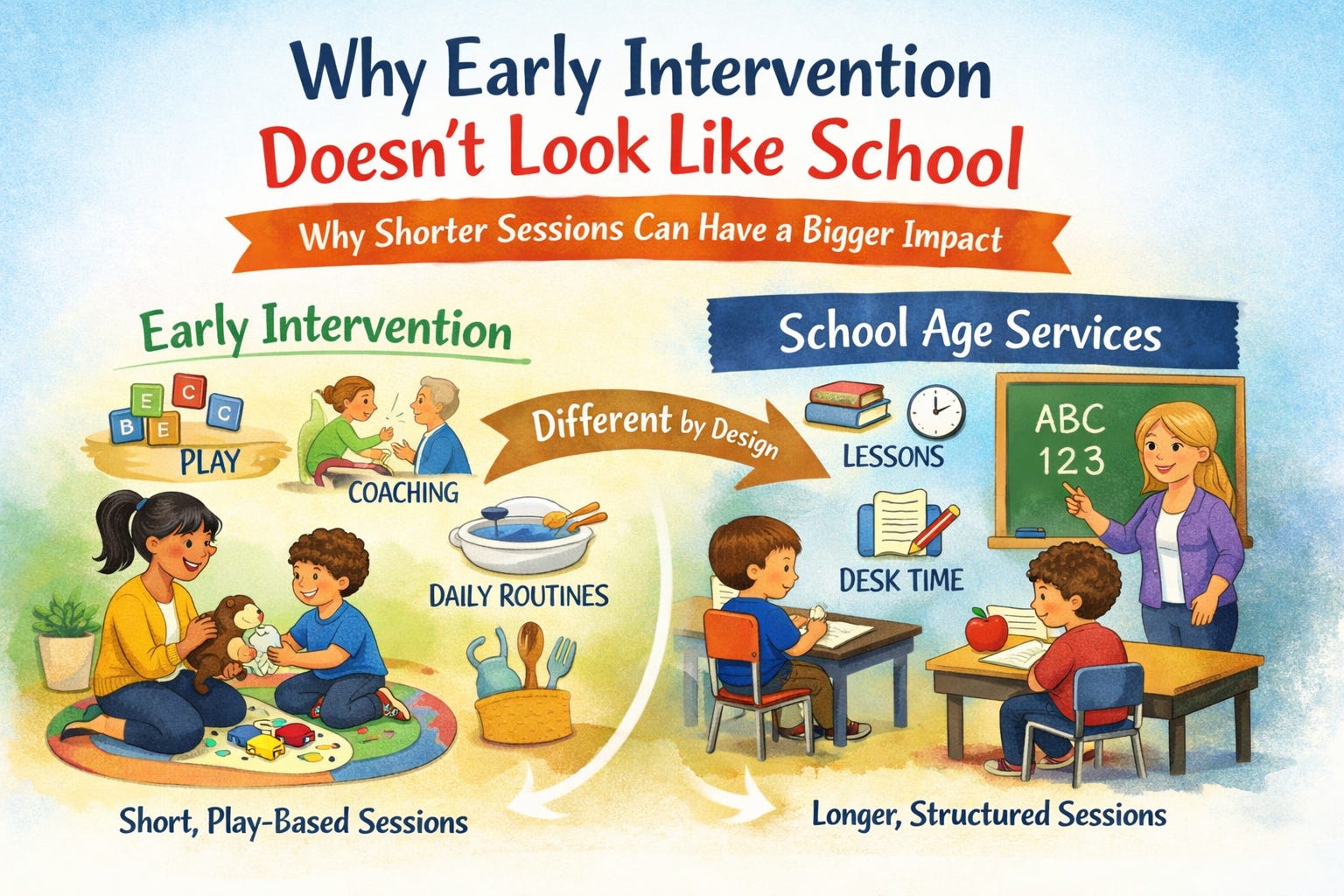
Families and school-age teams often notice that frequency and duration in Early Intervention look very different from what they see later in school—and that difference is intentional, appropriate, and evidence-based.
EI Is Built on How Young Children Learn
Young children do not learn best through long, isolated sessions.
They learn through short, repeated opportunities embedded throughout their day—during play, routines, and relationships.
Because of this, EI focuses on:
Consistency over intensity
Integration over isolation
Practice across the whole day, not just during service time
Frequency and Duration Support Skill Generalization
In EI, services are designed to:
Build skills gradually
Allow time for practice between visits
Support families and educators in using strategies all day long
Shorter or less frequent sessions are effective because learning continues when the provider leaves.
EI Services Are Embedded—Not Stand-Alone
Unlike school-age services, EI providers:
Coach teachers and families
Model strategies in real activities
Support routines rather than “pull-out” instruction
This means the impact of a 30–60 minute EI session often extends across many hours of the child’s day.
Development Is Still Emerging
In early childhood:
Attention spans are short
Regulation is still developing
Over-service can overwhelm rather than help
EI teams carefully balance support so that services:
Enhance participation
Do not disrupt natural learning
Match the child’s developmental readiness
More minutes does not automatically mean more progress.
Goals Are Developmental, Not Academic
EI goals focus on:
Communication
Social interaction
Motor development
Regulation
Independence in routines
These skills grow best through frequent natural practice, not extended drill-based instruction.
Progress Is Monitored Differently
EI teams:
Observe skills across environments
Adjust strategies collaboratively
Expect uneven growth (spurts and plateaus)
This allows teams to set service levels that are responsive, not rigid.
Why This Changes at School Age
Once children enter school age:
Expectations increase
Academic demands are added
Services shift toward curriculum access
As a result, frequency and duration often change—not because EI “did less,” but because the purpose of services changes.
The Bottom Line
Early Intervention is not about how much time a provider spends with a child.
It’s about how often learning happens when the provider isn’t there.
Different frequency and duration in EI:
Protect development
Support generalization
Empower families and teachers
Build long-term success